Patient Care
Selective Laser Trabeculoplasty (SLT)

Dr Minak Bhalla
Why is SLT recommended?
Glaucoma can sometimes be treated successfully with medications to lower the pressure in the eye. If medications are not effective, laser and other surgical procedures could be of value in controlling the pressure and preventing further vision loss. Both medications and surgery are designed to do one of two things:
Decrease the amount of fluid production in the eye from the cells that make the fluid
Help the fluid flow out of the eye
SLT is one option for lowering intraocular pressure (IOP) for patients who have open-angle glaucoma in the early stages. It can also be used in combination with drug therapy or as an alternative therapy when drugs fail. It is a flexible treatment option and can be repeated if necessary, depending on the individual patient's response.
How does SLT works?
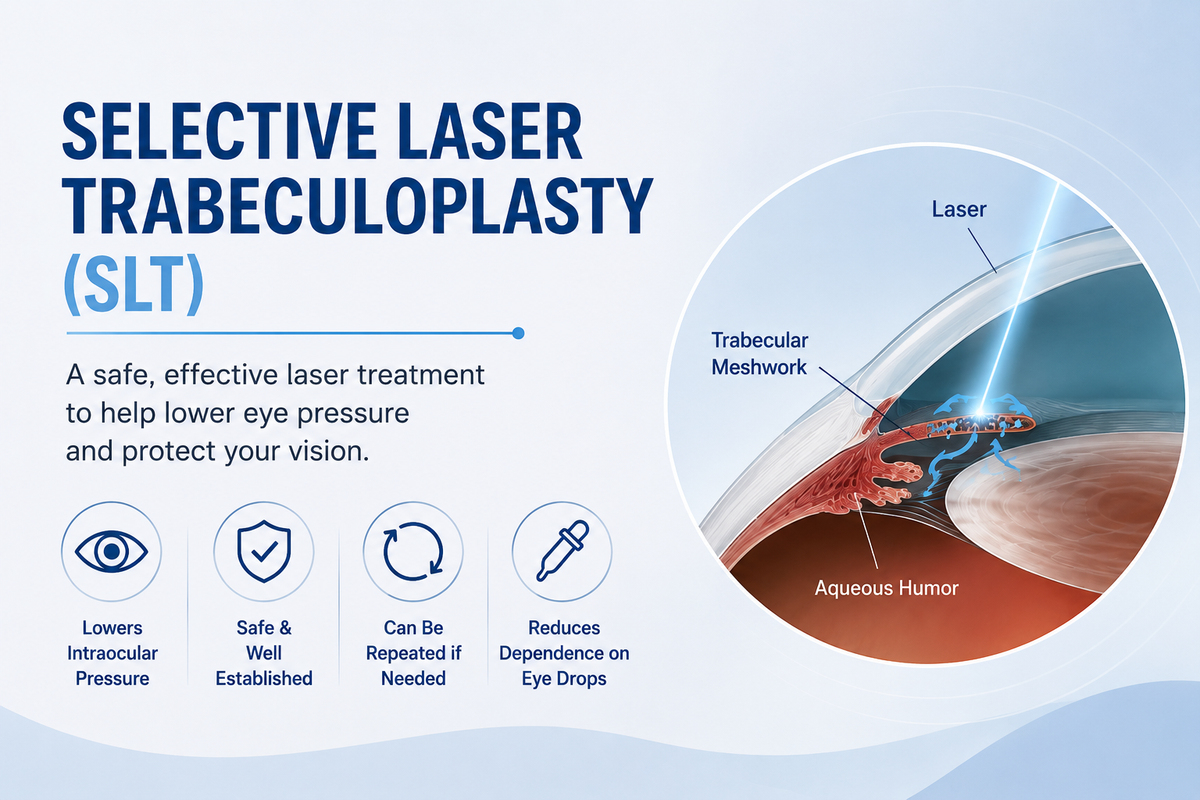
The trabecular meshwork is around the periphery of the iris and is where fluid formed in the eye drains out of the eye. This meshwork is treated directly with the laser to improve drainage through it.
SLT uses short pulses of relatively low-energy light to target only the melanin-rich cells in the drainage channel of the eye. The laser pulses affect only these melanin-containing cells, with the surrounding structure remaining unaffected. This gentle laser treatment induces a response from the body in which white cells are released to clear the affected cells and rebuild the meshwork so that it functions effectively again, reducing the IOP.
Benefits of SLT
SLT effectively lowers raised IOP without the side effects or difficulty of taking eye drops. The treatment is particularly suitable for patients who cannot correctly use or are intolerant to glaucoma medications and can also be used alongside medication to enhance the overall IOP-lowering effect.
SLT is a well-established treatment that has the advantage of not causing any lasting damage to the tissue treated.
The Treatment Procedure
Treatment takes place in the outpatient department. A member of Mr. Bhalla's team will check your vision and put some drops in your eye to prevent the pressure rising and to make your pupil small. These drops might cause a temporary headache and can take up to one hour to work.
Mr. Bhalla will take your written consent and, if you have any questions, will explain further before proceeding.
Once seated in front of the laser machine, which looks similar to the microscope used to examine your eyes in clinic, Mr. Bhalla's team will put anaesthetic drops in to numb the front of your eye. A special lens will then be placed against the front surface of your eye. This is not painful, but it might feel a little strange.
During the laser treatment, you might see some flashes of light and hear clicking noises. Most patients tolerate the laser treatment well, but some might feel slight discomfort. The procedure takes between 10 and 15 minutes.
About an hour after your treatment, a member of Mr. Bhalla's team will check the pressure in your eye. You will then be given a prescription for drops to take at home for five days. An appointment will be arranged for you to return to clinic, usually one to two weeks later. This follow-up appointment is to check that your eye is settling, although the treatment might take up to eight weeks to work fully.
Potential side effects
Your vision will be blurred for a few hours following your laser treatment, but this will settle. The chance of your vision being permanently affected by SLT is extremely small. If you are concerned that your vision is not returning to normal, please contact Mr. Bhalla's team using the details below.
You are also advised not to drive yourself to or from your appointment, as you will be unable to drive home following the procedure.
It is possible for the pressure in your eye to increase immediately after the treatment and for there to be some inflammation. In order to prevent this, Mr. Bhalla's team will put in special drops when treating you. Steroid drops, and occasionally extra glaucoma drops, are also provided following treatment.
Rarely, the pressure in the eye rises to a very high level and does not come down. If this happens, surgery to lower the pressure may be required. However, please be assured that this is a very unusual occurrence.
Success Rate
Studies show a 78% success rate for SLT, with some patients responding well to the treatment, but others not responding at all. Usually, it is not possible to predict how well the laser will work, as your response is determined by the type of glaucoma you have and the individual make-up of your eye.
If you take eye drops for glaucoma, you will usually need to continue these to lower the pressure after laser trabeculoplasty. It will take up to eight weeks after the laser treatment for the pressure to be reduced.
You might require additional laser surgery to lower the pressure if it is not at a sufficiently low level after your first treatment. The effects of the laser treatment may wear off in time, about half of all treatments stop working after five years. However, the treatment can be repeated.
Contact Us
If you have any concerns before or after your procedure, please do not hesitate to get in touch with Mr. Bhalla's team.
Mr. Minak Bhalla | Consultant Ophthalmologist
+44 20 3355 7738
secretary@minakbhalla.co.uk