Patient Care
Chalazion Meibomian Cyst

Dr Minak Bhalla
What is Chalazion?
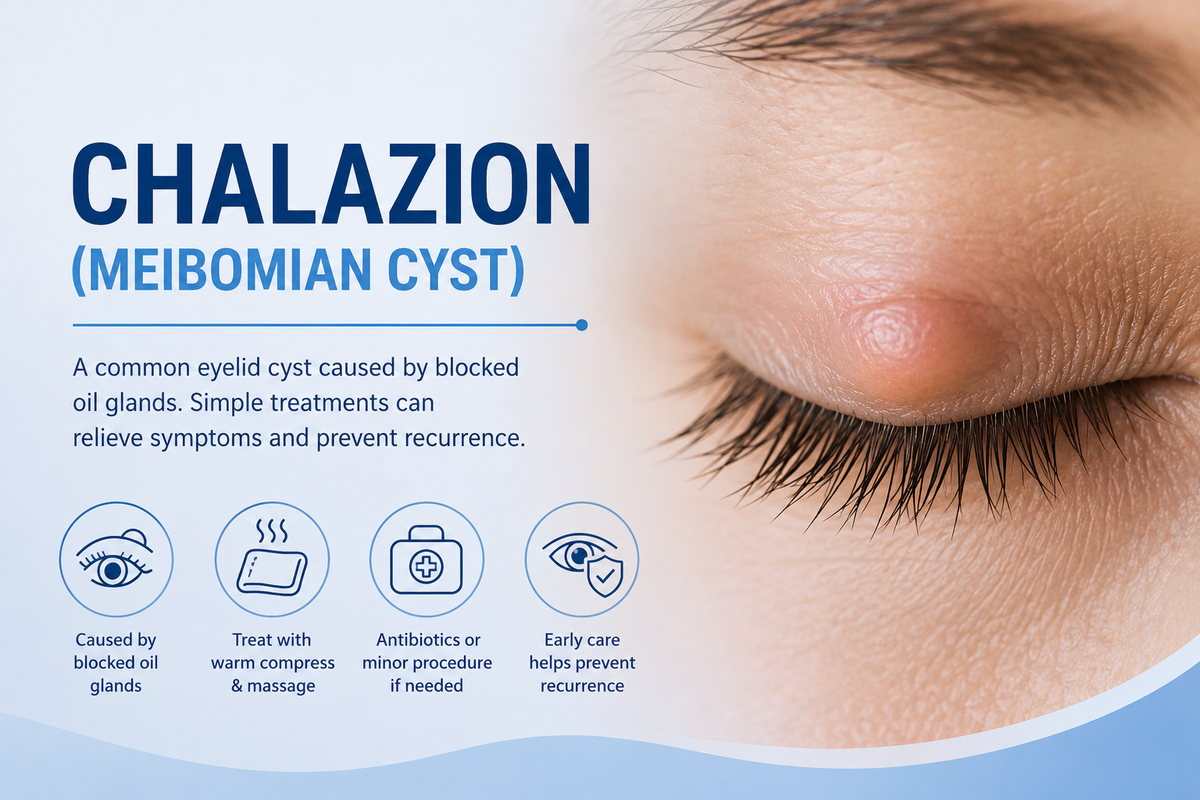
A chalazion (also known as a meibomian cyst) is a cyst in the eyelid. A common condition, it often occurs due to inflammation around the opening of the oil glands at the base of the eyelashes. The inflammation (called blepharitis) is caused by sensitivity to a common bacteria found on the skin. When the opening of the small oil glands around the lashes becomes blocked by inflammation, a small tender swelling occurs in the eyelid. This is known as a chalazion.
FIRST-LINE TREATMENT
The first stage of treatment involves using a warm compress and massaging your eyelid:
Warm compress: Boil some water and let it cool a little, or use water from the hot tap. Soak cotton wool or a clean flannel in the warm (but not boiling) water, squeeze it out and gently press onto your closed eyelids for two to three minutes at a time.
Massage: Starting at the skin crease, gently massage the upper lid downwards towards the lashes. The lower lid should be massaged upwards towards the lashes. This may release the contents of the cyst, meaning further treatment will not be necessary.
Antibiotics may also be prescribed to reduce the inflammation.
SURGICAL DRAINAGE
If the chalazion does not respond to first-line treatment, it can be drained. Mr. Bhalla's team will arrange a date for you to come in for this minor procedure and will advise you where to check in on the day.
On arrival, a member of Mr. Bhalla's team will admit you and examine you. Mr. Bhalla will discuss the risks and benefits of the surgery and the type of anaesthetic that can be given. You will also be asked to sign a consent form to confirm that you are aware of the risks and benefits and agree to go ahead with the operation.
Benefits of surgery:
The inflamed chalazion will be drained, relieving the swelling and discomfort.
Risks involved:
Your eyelid might be swollen and bruised for several days after your operation, but this should settle after two weeks.
There is a risk of infection, but after the operation you will be given antibiotic ointment to apply, which should help prevent this.
A chalazion can come back after being removed. If this happens, please apply a warm compress to your closed eyelid as described above. Please contact Mr. Bhalla's team if your chalazion persists despite this, as further treatment and investigation may be required.
THE PROCEDURE
Mr. Bhalla will explain the procedure again before starting. Once you are lying comfortably on the operating table, the skin around the chalazion will be injected with local anaesthetic. This will sting at first but the lid will soon become numb. Although you will still be able to feel touch and pressure, you should not feel any pain.
Mr. Bhalla will then make a small incision on the inner surface of your eyelid so that the contents of the cyst can be drained. Ointment will be applied and a pad placed over your eye. You will be able to go home on the same day.
Sometimes a biopsy of the cyst will be taken. If this is done, a member of Mr. Bhalla's team will contact you with the results, or a clinic appointment will be arranged if needed.
AFTERCARE AND ADVICE
When the anaesthetic wears off, there may be some discomfort. To relieve this, you can take mild pain relief such as paracetamol. You should keep the pad over the eye for at least four hours, as this reduces swelling and bruising.
When you remove the pad, you will find some blood or discharge around your eye. Clean the eyelid with cooled boiled water and use the antibiotic ointment as prescribed by Mr. Bhalla's team.
As this is a minor procedure which only involves surgery on the eyelid and not the eye itself, it should not affect your ability to work. If it does, please speak to your GP to discuss taking time off work.
WHEN TO SEEK ADVICE
Please contact Mr. Bhalla's team promptly, or attend your nearest eye casualty department, if you experience any of the following:
Blurred vision
Bleeding from the eye or eyelid
Increasing pain, redness or swelling that is not improving.
Mr. Minak Bhalla | Consultant Ophthalmologist
+44 20 3355 7738
secretary@minakbhalla.co.uk