Cataract
Cataract Surgery: What Lens Replacement Options Are Available?

Dr Minak Bhalla
Clear vision allows us to experience the world at its best — from recognising familiar faces to reading our favourite books. As we age, the natural lens in our eyes can gradually become cloudy, causing blurred vision and increasing difficulty with everyday tasks. This clouding of the lens is known as a cataract. Cataracts are most common in adults over the age of 60 and occur when the natural lens loses its transparency, causing light entering the eye to scatter rather than focus precisely on the retina.
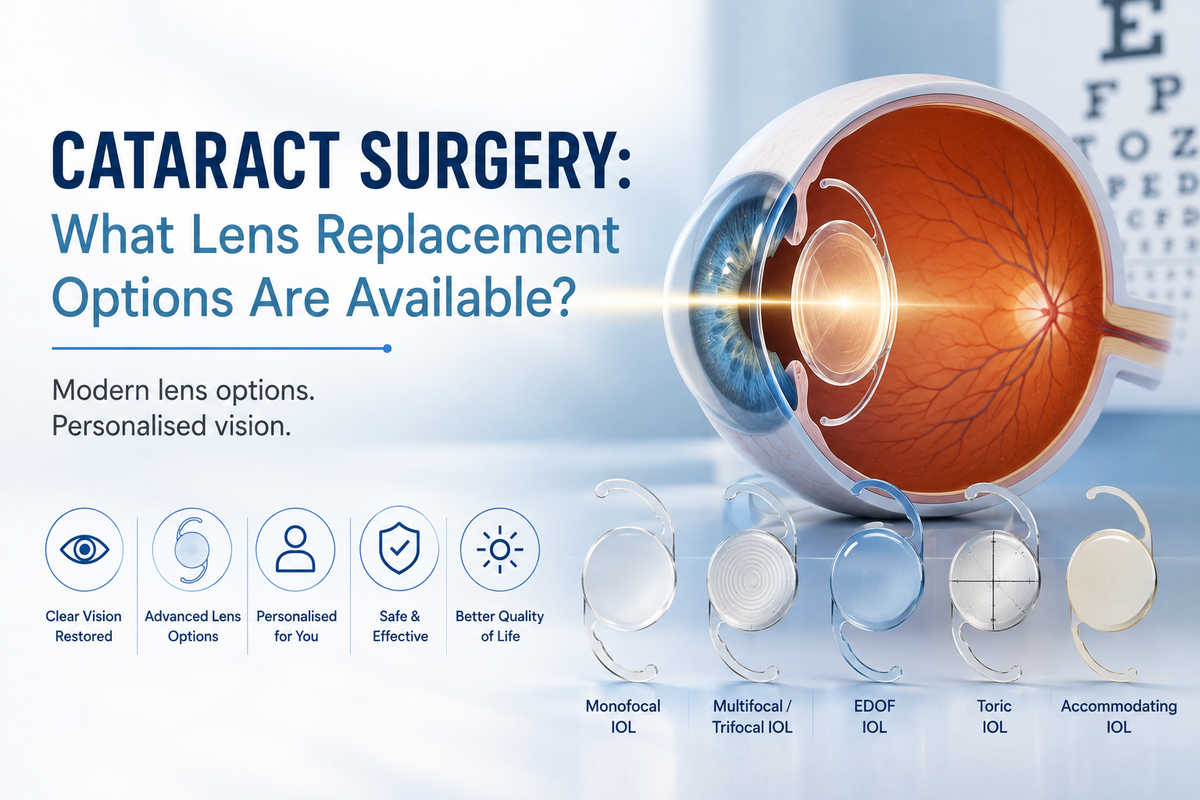
Modern cataract surgery is the most effective treatment for cataracts. It involves removing the clouded natural lens and replacing it with an artificial intraocular lens (IOL). Advanced IOL technology now offers multiple lens types that not only restore vision but can also correct pre-existing refractive errors such as myopia (short-sightedness), hypermetropia (long-sightedness), and astigmatism (irregular corneal curvature). The most appropriate lens varies from person to person and depends on individual eye health, lifestyle, and visual priorities.
What is an Intraocular Lens?
An intraocular lens is an artificial lens implanted into the eye following removal of the natural lens during cataract surgery. IOLs are manufactured from different materials, including hydrophobic acrylic, hydrophilic acrylic, and silicone, each with different optical properties suited to different patients.
Types of Intraocular Lens
If you are considering cataract surgery, there are several IOL options available. The most common types are outlined below.
Monofocal IOL
A monofocal IOL provides clear vision at a single fixed distance, most commonly set for distance vision. It is the most widely used IOL type and is funded by the NHS as the standard lens option.
Who is it ideal for
- Patients who are comfortable using glasses for near and intermediate tasks after surgery
- Patients with co-existing eye conditions such as glaucoma, macular disease, or retinal disorders, where premium lenses may not be suitable
Multifocal and Trifocal IOL
Multifocal IOLs are designed to provide vision at more than one focal point. The most advanced form — the trifocal IOL — offers three distinct focal points: near, intermediate, and distance, and represents the current standard in premium multifocal lens technology.
Who is it ideal for?
- Patients who want to minimise dependence on glasses for most daily activities
- Patients who regularly switch between near and distance tasks
- Patients with no significant co-existing eye disease
Extended Depth of Focus (EDOF) IOL
Rather than creating separate focal points, EDOF lenses extend the range of focus along a continuous plane, providing good intermediate and distance vision with reduced visual disturbances compared to multifocal designs.
Who is it ideal for?
- Patients who want to reduce glasses dependence without the visual disturbances (such as halos or glare) that some patients experience with multifocal lenses
- Professionals who spend long hours at a computer screen
- Patients who prioritise distance and intermediate vision over near vision tasks such as reading small print
Toric IOL
Toric IOLs are specifically designed to correct corneal astigmatism alongside cataract. They are aligned to the axis of astigmatism during surgery to deliver improved distance vision without the need for cylindrical spectacle correction.
Who is it ideal for?
- Patients with pre-existing corneal astigmatism
- Patients who experience blurred or distorted vision due to astigmatism
- Patients who wish to achieve clear distance vision without glasses for cylindrical correction after surgery
Accommodating IOL
Accommodating IOLs are designed to respond to the contraction of the eye's ciliary muscles by shifting position within the eye, which can provide a limited range of focus. They differ from the natural lens, which achieves focus by changing shape; accommodating IOLs work primarily through forward translation within the capsular bag. It is worth noting that the evidence for their effectiveness remains variable, and outcomes differ between individual patients and lens designs. Your surgeon will discuss whether this option is appropriate for your specific needs.
Who is it ideal for?
- Patients seeking a more natural range of focus who are not suitable candidates for multifocal lenses
- Patients with healthy eye structures and realistic expectations about visual outcomes
Which IOL is Right for You?
Selecting the right IOL requires a personalised assessment by an experienced ophthalmologist. Several factors guide the decision.
Eye Health
The overall health of the eye plays a central role. Patients with healthy eyes may be suitable candidates for multifocal, trifocal, EDOF, toric, or accommodating lenses. Patients with co-existing eye conditions such as glaucoma, macular disease, or significant corneal disorders are generally better suited to monofocal lenses, which carry fewer optical trade-offs.
Refractive Error
Assessment of the pre-existing refractive status informs IOL power selection. For patients with astigmatism, toric IOLs are preferred as they address the cylindrical component of the prescription and improve post-operative unaided distance vision. For patients with myopia or hypermetropia, IOL power is calculated to target the desired post-operative refraction, typically distance focus; any residual need for reading glasses is driven primarily by presbyopia, which is present in most patients undergoing cataract surgery, rather than the refractive error itself.
Lifestyle and Visual Priorities
Daily activities are central to lens selection. Patients who read frequently, use smartphones regularly, or require clear near vision for their work may prefer multifocal, trifocal, or EDOF lenses to reduce glasses dependence. Patients who drive frequently, particularly at night, may prefer monofocal or EDOF lenses due to better contrast sensitivity and fewer issues with night-time visual disturbances. Professionals requiring prolonged computer use may find EDOF lenses particularly well suited to intermediate screen distances.
Selecting the right IOL can feel complex without specialist guidance. If cataracts are beginning to affect your daily life and you would like advice on which lens option is most appropriate for your needs, you can book a consultation with Mr. Minak Bhalla. Mr. Bhalla is an experienced cataract and glaucoma surgeon based at Harley Street, London, with over ten years of expertise in cataract surgery. He offers personalised cataract assessment and a range of advanced IOL options to help you achieve the clearest possible vision after surgery. Book your appointment at The London Clinic, 119 Harley Street, London W1G 6AU, or at Clementine Churchill, Harrow, HA1 3RX.
Frequently Asked Questions
1. What lens replacement options are available for cataract surgery?*
Cataract surgery lens options include monofocal lenses, multifocal and trifocal lenses, extended depth of focus (EDOF) lenses, toric lenses, and accommodating lenses. Each type is suited to different visual needs, eye health profiles, and lifestyle priorities.
2. Which cataract lens is best for me?*
The most suitable lens depends on factors including your eye health, pre-existing refractive errors, lifestyle, and visual expectations. A thorough consultation with an ophthalmologist will help determine the most appropriate option for you.
3. Are multifocal lenses suitable for everyone?
No. Multifocal and trifocal lenses are generally most appropriate for patients who want to reduce dependence on glasses and do not have significant co-existing eye disease such as glaucoma or macular conditions. Your surgeon will advise whether they are suitable for you.
4. Will I still need glasses after cataract surgery?
This depends on the type of IOL chosen and your individual prescription. Monofocal lenses are likely to require glasses for near and intermediate tasks. Multifocal, trifocal, and EDOF lenses are designed to reduce, though not always eliminate, glasses dependence for most daily activities.
5. Where can I get private cataract surgery at Harley Street, London?
You can consult Mr. Minak Bhalla, an experienced cataract surgeon at Harley Street, London, for a personalised cataract assessment, lens selection advice, and cataract surgery tailored to your individual visual needs.