Cataract
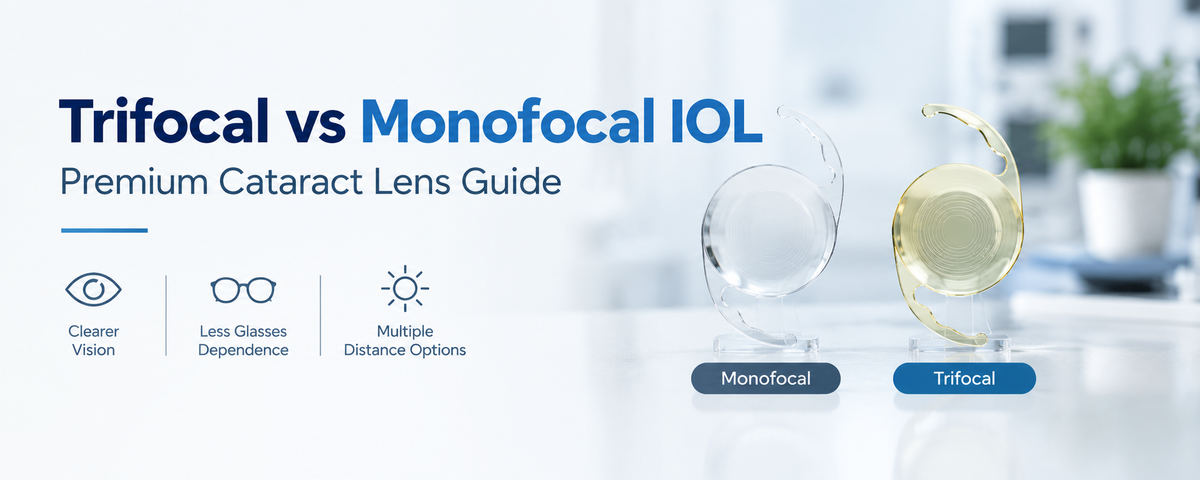
Trifocal vs Monofocal IOL: Premium Cataract Lens Guide

Mr Minak Bhalla
Cataract is the clouding of the eye's natural lens that can gradually cause your vision to lose its clarity, and make the world appear as though viewed through a misty window. Modern cataract surgery opens the door to a range of premium intraocular lens (IOL) options for you. For people considering cataract surgery in London, the biggest dilemma remains, choosing the right intraocular lens. This is a quick guide to help you explore the premium cataract lens options available in London and get an idea of which may be the best suit for your personal visual needs.
What is an intraocular lens?
An intraocular lens is an artificial lens implanted inside the eye during cataract surgery. In modern cataract surgery, a clear intraocular lens is used to replace the cloudy natural lens of the eye that causes vision problems. The surgery itself is done under local anaesthesia and takes a relatively short time, usually allowing most patients to return home the same day.
Different IOL options are designed to offer clear vision at different ranges. Two popular choices among the various types of cataract lens available in London are the monofocal and the trifocal lenses.
Monofocal vs trifocal IOL: A quick glance at the key differences
Main focal point:
Monofocal lens: One distance.
Trifocal lens: Multiple distances – near, intermediate and far.
Spectacle dependence:
Monofocal lens: Glasses often required for reading or use of phones.
Trifocal lens: Significantly reduced.
Side effects: Halos and glares: Monofocal lens: Less likely to occur. Trifocal lens: More common.
Contrast sensitivity:
Monofocal lens: Generally well preserved. Trifocal lens: Reduced compared to monofocal lenses.
Suitability:
Monofocal lens: Suitable for a broad range of patients. Trifocal lens: Requires careful patient selection, less suitable for patients with coexisting eye diseases.
What is a monofocal lens?
A monofocal IOL is designed to provide clear vision at one specific distance- near, intermediate or far. The near focused IOL helps with reading books, using phones or close-up works. Intermediate distance focused IOL is useful for computer work while far focused IOL can provide clear vision during driving, outdoor activities or watching TV. You can achieve clear vision at only one chosen distance, while vision at the other two distances still remain blurry.
Advantages of monofocal lens
High quality, clear vision at the chosen focal distance
Generally provides good contrast sensitivity
Fewer glares, halos and night vision disturbances compared to trifocal lens
Suitable for a wide range of patients, including ones with coexisting eye conditions
Usually more affordable than trifocal lens
Disadvantages of monofocal lens
Cannot provide clear vision across a wide range of distances, only limited to one distance (near/intermediate/far)
Dependence on glasses for near (reading, phone use) and intermediate tasks (computer work) if the chosen monofocal lens is set for far distance
Who is it ideal for?
Monofocal lens is ideal for individuals who -
Want to focus on achieving excellent and clear vision at one certain distance
Feel comfortable using glasses for near and intermediate tasks after the cataract surgery
Have coexisting eye conditions such as glaucoma or retinal conditions, where multifocal lens is not recommended
Prefer to avoid side effects like halos and glares
Often drive at night
What is a trifocal lens?
Unlike a monofocal lens, a trifocal IOL is designed to provide a full range of clear vision at multiple focal points– near, intermediate and far. The aim of using a trifocal lens is to reduce dependence on glasses for various activities for most patients. It represents an advanced form of premium multifocal lens technology, providing a broader range of vision.
Advantages of trifocal lens
Improves vision at multiple distances- near, intermediate and far
Can significantly reduce dependence on glasses for regular activities after surgery
Useful for people who frequently read, use phones or work on computers
Provides a broader range of vision with a single lens
Disadvantages of trifocal lens
May cause halos, glare and other visual side effects, particularly at night or in low light. - most patients adapt over weeks to months
Contrast sensitivity is lower than monofocal lens
Generally not recommended for patients with significant coexisting eye conditions — suitability depends on the nature and severity of the condition
Visual adaptation can take time as the brain adjusts to the multifocal optical system
Can be more expensive than monofocal lens
Who is it ideal for?
Trifocal lens is ideal for for patients who-
Want to achieve minimised dependence on glasses for most daily activities after surgery
Regularly switch between tasks requiring clear near and distance vision
Have healthy eyes with no coexisting vision problem
Do not drive at night frequently
Are comfortable with a longer adaptation period after the lens replacement
Who is it less suitable for?
Trifocal lenses split incoming light and reduce image contrast sensitivity, severely worsening vision when the eye is already compromised by other coexisting eye diseases.
Trifocal lens may not be suitable for you if you have-
Uncontrolled dry eyes
Macular diseases or retinal conditions
Advanced glaucoma or optic nerve issues
Require a very sharp vision in low light conditions
Which option is suitable for patients with astigmatism?
If you have astigmatism, the ophthalmologist may recommend toric lens to you. Toric IOLs are specifically designed to correct astigmatism along with cataract. It is available in both options –
Toric monofocal lens
Toric trifocal lens
Which IOL option is right for you?
When it comes to choosing the right IOL, no single IOL is right for everyone. You need a consultation with an experienced ophthalmologist who can guide you in choosing the right lens for you based on your personal needs. A detailed eye examination is particularly essential for deciding on the right premium lens option. Your ophthalmologist will consider factors such as your-
Eye health
Existing prescription
Corneal measurement
Retinal and optical nerve health
Presence of astigmatism
Lifestyle requirements (reading, computer use etc.)
Night driving habits
Expectations regarding dependence on glasses after surgery
Visual expectations
Looking for an experienced cataract surgeon in Sudbury Hill?
If the world is starting to look cloudy and daily activities are becoming harder to navigate, cataract may be the cause. If you are considering cataract surgery and need expert advice on which premium lens option is right for you, you can book an appointment with Mr. Minak Bhalla. He is an experienced cataract surgeon in Sudbury Hill with 10 years of experience in treatment of cataract surgery. Mr. Bhalla completed his ophthalmological training at Moorfields Eye Hospital, Royal Free Hospital, and Western Eye Hospital, where he developed exquisite skills in complex advanced surgical procedures. He offers detailed personalised cataract assessment and a comprehensive range of advanced premium intraocular lens options to help you see the world clearer. Get your appointment today at The Clementine Churchill Hospital in Sudbury Hill, Harrow HA1 3RX and The London Clinic in 119 Harley Street, London W1G 6AU.