Patient Care
Cataract Surgery: Symptoms, Treatment, Risks & Lens Options

Dr Minak Bhalla
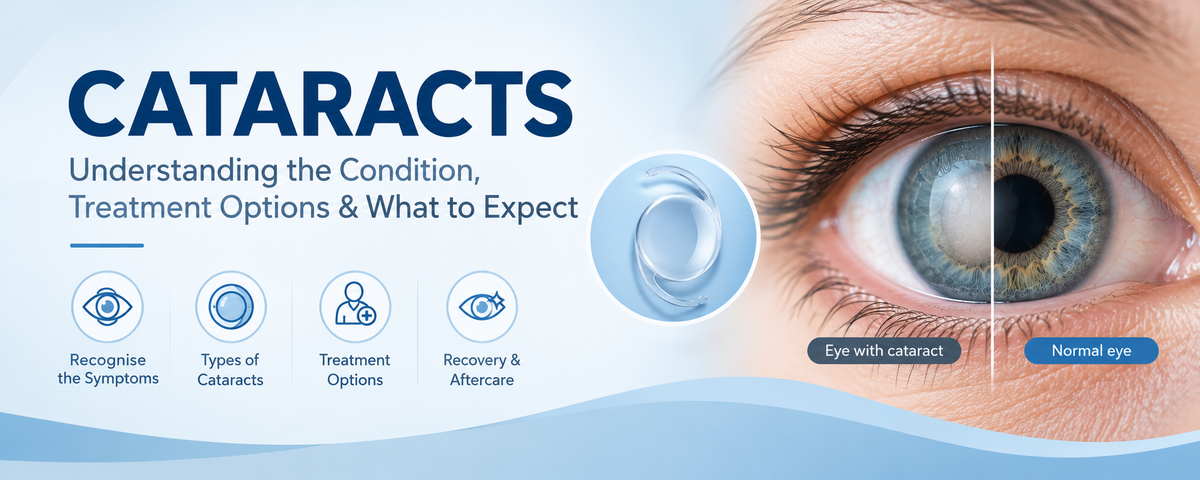
A cataract is a clouding or opacity of the lens inside the eye. It is useful to learn about how the eye works in order to understand what a cataract is.
Inside the eye, behind the coloured part (the iris) with a black hole in the middle (the pupil), is the lens. In a normal eye, this lens is clear. It helps focus light rays on to the back of the eye (the retina), which sends messages to the brain allowing us to see. When a cataract develops, the lens becomes cloudy and prevents the light rays from passing through.
What symptoms do cataracts cause?
Cataracts usually form slowly over years causing a gradual blurring of vision, which eventually is not correctable with glasses. In some people the vision can deteriorate relatively quickly. Developing a cataract can also cause glare, difficulty with night-time driving and multiple images in one eye which can affect the quality of vision.
ARE THERE DIFFERENT KINDS OF CATARACT
Yes. Most cataracts are age-related, but other examples include congenital (present at birth), drug-induced (steroids), and traumatic (injury to the eye).
IS THERE A LINK BETWEEN DIABETES AND CATARACTS?
Yes. Cataracts are more common in people who have certain diseases such as diabetes.
DO CATARACTS SPREAD FROM EYE TO EYE?
No. But often they develop in both eyes either at the same time or one after the other with a gap in between.
ARE CATARACTS JUST A PART OF GETTING OLD?
Most forms of cataract develop in later adult life. This is called age-related cataract, and can occur at any time after the age of 40. The normal process of ageing causes the lens to gradually become cloudy. Not all people who develop a cataract require treatment.
CAN CHILDREN HAVE A CATARACT?
Yes, but this is rare.
I DIDN'T KNOW THAT I HAD A CATARACT UNTIL MY OPTICIAN TOLD ME – IS THAT NORMAL?
At first, you might not be aware that a cataract is developing and initially it may not cause problems with your vision. Generally, as a cataract develops over time, you start to experience blurring of vision. In most cases, eyes with a cataract look normal but, if the cataract is advanced, your pupil may no longer look black and can look cloudy or white. You may need to get new prescription glasses more frequently when the cataract is developing. Eventually, when your cataract worsens, stronger glasses may no longer improve your sight and you might have difficulty seeing things even with your glasses on.
ASSESSMENT OF CATARACT
During a consultation with Mr Bhalla, you will be asked about your sight problems, any other eye conditions and your general health. Your vision will be tested and measurements taken with specialist equipment, which will help us to make recommendations about the best treatment for your vision problem.
You will be given eye drops to make your pupil bigger, so that we can examine your eyes fully. The drops will blur your vision and the effect of the drops will take a few hours to wear off.
For this reason, you are advised not to drive after your hospital appointments. You should also take care that you do not miss your footing and be very careful with steps while your vision is still blurred.
TREATMENT
When do I have my cataract treated?
In many cases, cataracts are harmless and may be left in your eye. It is usually safe not to have surgery if you feel that you do not have a problem with your vision or do not wish to have an operation. When the cataract progresses to the point that it is interfering with daily activities or lifestyle, even when using up-to-date glasses, then cataract surgery may be the next step. Modern surgery is highly successful for the majority of patients but, as with all surgery, there are risks. Cataract surgery is performed when you have a problem with your vision and you want to do something about it.
Can anything be done to stop my cataract worsening?
There is no known method of preventing cataracts developing.
I have a cataract developing in both eyes – are both operated on at the same time?
Most people develop cataracts in both eyes. Your cataract surgery can be performed on different days, which may be inconvenient due to any imbalance in the glasses prescription and extra hospital visits. Some patients choose to have both cataracts operated on the same day with immediate sequential bilateral cataract surgery. Having both eyes operated on the same day means there is only one admission, one recovery period and one postoperative review. Your surgical team will be able to advise on the suitability, as well as the risks and benefits of having surgery on both eyes at the same time.
On the day of surgery, once the first eye cataract surgery is completed satisfactorily, Mr Bhalla will perform surgery on the second eye. You will remain in the operating theatre throughout, but the two procedures are independent, using separate surgical instrument sets and drapes. The surgical risks and refractive outcomes are equivalent to performing the cataract surgeries on different days.
INSTRUCTIONS BEFORE SURGERY
Mr Minak Bhalla’s team will advise you on what you need to do prior to surgery. It is important that you remove all eye makeup before surgery to reduce the risk of infection. You should also not wear eye makeup for at least one week after your surgery.
Do I need any special tests before the operation?
Yes. Special tests are required to determine the strength of the lens implant which is inserted into the eye. These tests are done before the operation day, either at your first clinic attendance or during your booked pre-assessment appointment.
Prior to your special tests, if you wear contact lenses, you must leave them out for the following time unless told otherwise:
1 week for soft lenses
2 weeks for any types of rigid lenses including gas permeable lenses
You may also have tests for your general health, such as blood tests and an electrocardiogram (ECG).
I have had previous laser treatment to my eyes. Does it matter?
Excimer lasers (e.g. LASIK and PRK) are used to reduce the need for glasses, most commonly in short-sighted younger people. If you have had laser treatment, it is very important that you tell Mr Bhalla or his team during your assessment. Excimer laser treatment affects the calculations that are used to determine the strength of the lens implant that is inserted. Even though allowance is made for the laser treatment, it is more difficult to select the power of the lens implant and patients are at higher risk of being more or less long/short-sighted than planned following the cataract surgery. This may require glasses or contact lenses to be worn or may be correctable with further excimer laser surgery or further intraocular surgery.
WHAT DOES THE CATARACT OPERATION INVOLVE?
Mr Minak Bhalla will carry out your operation. Your eye is never removed and replaced when operations are carried out.
The most common form of cataract surgery performed is using a small incision (wound) and a process called "phacoemulsification", often shortened to "phaco". This technique uses ultrasound to soften the lens, which is then broken up and flushed out using fine instruments and special fluids. A clear artificial lens (intraocular lens implant or IOL), made of a plastic-like material, is placed inside the eye. The back membrane of the lens (capsule) is left behind and this holds the artificial lens in place.
The wound is very small and most patients do not require stitches, although very fine stitches are sometimes needed to close the wound safely. This can occasionally cause some temporary post-operative irritation. Depending on the type of stitch used, these may need to be removed. The removal of the stitches is usually done in the clinic and is a quick and painless procedure.
Are cataracts removed by laser?
New technology is available using a specially designed laser for part of the procedure. However, Mr Bhalla still needs to operate to complete the surgery as it is currently not possible to remove a cataract via laser alone. Lasers are not in routine use for cataract surgery except as part of clinical trials.
WHAT IS IT LIKE DURING THE OPERATION?
The operation is performed while you are lying down on your back. Your face is partially covered by a sterile sheet. If you have difficulty lying flat or are claustrophobic, we will do our best to make sure that you are comfortable before the operation starts, but please tell Mr Bhalla’s team this during your pre-operative assessment.
During the operation, Mr Bhalla uses a microscope and the bright light from the microscope and the covering sheet means that you do not see the operation or the detail of the instruments but you may see moving shapes. Usually you will be awake during the operation and will be aware of a bright light, and often coloured lights and shadows. You may feel the Mr Bhalla’s hands resting gently on your cheek or forehead.
A lot of fluid is used during the operation. Sometimes, excess fluid may escape under the sheet and run down the side of your face, into your ear or on your neck, which can be uncomfortable. You might hear conversations during the operation. These could be about the operation or for teaching or about other subjects. Please do not join in as it is important that you remain still during the procedure.
WHAT KIND OF ANAESTHETIC IS NECESSARY?
Most operations for cataract are performed under local anaesthetic, in which you are awake but your eye is numb. This is usually given by eye drops or an injection around your eye. A small number of patients require sedation or even a general anaesthetic, where you are asleep.
Will I have to stay in hospital?
Cataract surgery is performed on a day-care basis. This means you are admitted to hospital, have your operation and are discharged home all in the same day. You could spend several hours in hospital from arrival to discharge.
WHAT ARE MY CHOICES FOR VISION AND GLASSES AFTER THE OPERATION?
One of the most important decisions before your cataract operation is choosing the type of lens implant (intraocular lens, or IOL) that will replace your cloudy natural lens. This decision will affect how well you see after surgery and how much you depend on glasses. There are several options, ranging from standard lenses to premium lenses available privately. Mr Bhalla will discuss the most appropriate option for your individual needs, lifestyle and eye health.
STANDARD MONOFOCAL LENSES
Your lens, which helps you focus, is removed during the operation and is replaced with an artificial lens, the intraocular lens implant. There is a choice of different strengths (powers) of lenses which, just like different strengths of glasses lenses, affect how clearly you see when looking into the distance or when looking at near things such as reading a book.
During your initial assessment, the cataract team will discuss with you whether you want to have better focus for close vision or for distance vision. Most people choose to aim for good distance vision after the operation. If you choose this option, you will usually need reading glasses and you may still need glasses for fine focusing in the distance. Some people choose to aim for good close vision, especially if they like to read without glasses or do a lot of detailed close work such as embroidery. If you choose this option, you will need glasses for distance.
MONOVISION
Combining a clearer distance focus in one eye with a clearer focus at arms' length is a good option if you have no strong preferences and had good vision in both eyes, with or without glasses before the cataracts developed. Spreading the focus between the eyes in this way does not normally stop them working together or make you feel unbalanced, and it helps you to do more activities comfortably without glasses. You will probably still prefer to wear glasses for at least some activities after surgery and it may take you a few weeks to get used to your new vision. This option requires careful consideration and may not be suitable for all patients.
TORIC LENSES – ASTIGMATISM-CORRECTING LENSES**
Toric lenses are available for some patients undergoing cataract surgery who have moderate to high astigmatism. A toric lens is made of the same material as a standard non-toric lens, but also incorporates astigmatism correction. The aim is to improve your vision so that the need for distance glasses is minimised but, as with standard lenses, you will still need to wear glasses for close up work.
Toric lenses are not required if you are happy wearing glasses for distance, and are not suitable if you have other eye problems apart from cataract and high astigmatism. The surgery is the same as standard cataract surgery except, once the toric lens has been inserted, it is carefully rotated to the correct position for each patient.
There are some potential issues with toric lenses:
A toric lens may not fully correct the astigmatism and you may still need glasses for distance.
If complications occur during cataract surgery, it may not be possible to insert a toric lens.
The lens can rotate and a second operation may be needed to rotate the toric lens back into position for best vision, with the additional risk of further surgery.
Some patients may require further surgery to remove the toric lens and replace it with a standard lens.
The alternative options for those with high astigmatism are glasses or contact lenses. Laser refractive procedures can also correct astigmatism.
PREMIUM LENSES
For patients who wish to reduce their dependence on glasses as much as possible, a range of premium lens implants is available. These lenses are designed using advanced optical technology to provide a broader range of clear vision than standard monofocal lenses.
It is important to understand that no lens can fully replicate the natural focusing ability of a young, healthy eye, and premium lenses are not suitable for everyone. Mr Bhalla will assess your eyes and your lifestyle carefully before recommending a premium lens.
What types of premium lens are available?
Multifocal Lenses (Bifocal and Trifocal)
Multifocal lenses have two or more distinct optical zones built into the lens, similar in principle to bifocal or trifocal spectacle lenses. Bifocal IOLs provide two focal points (typically distance and near), while trifocal IOLs provide three focal points (distance, intermediate such as computer distance, and near).
Evidence suggests multifocal IOLs can provide uncorrected distance vision of good quality in approximately 82–96% of patients, with spectacle independence achieved in around 81–85% of patients overall.
The main advantages of multifocal lenses are:
Reduced dependence on reading and distance glasses
Good range of vision for many everyday tasks
Trifocal models also offer improved intermediate vision (such as computer screens) compared to bifocal models
The main limitations of multifocal lenses include:
Some patients experience visual disturbances such as glare, haloes around lights and starbursts, particularly at night
Contrast sensitivity (the ability to distinguish fine detail in low-contrast conditions) may be slightly reduced compared to monofocal lenses
They are generally not recommended for patients with other significant eye conditions such as glaucoma, macular degeneration or corneal disease
Results are not guaranteed and a small number of patients may ultimately prefer to have the lens exchanged
Extended Depth of Focus (EDOF) Lenses
Extended depth of focus IOLs represent a newer category of premium lens. Rather than creating separate focal points like multifocal lenses, EDOF lenses use a single elongated focal zone to provide a continuous range of clear vision, primarily at distance and intermediate ranges.
Studies have shown that EDOF lenses provide good distance and intermediate vision with a lower incidence of glare and haloes compared to multifocal lenses.
The main advantages of EDOF lenses are:
Good distance and intermediate vision (useful for driving, computer use and most daily tasks)
Lower rates of visual disturbances such as haloes and glare compared to multifocal lenses
Better contrast sensitivity than multifocal lenses in many patients
The main limitations of EDOF lenses include:
Near vision (such as reading small print) may not be as sharp as with trifocal lenses, and reading glasses may still be required for some tasks
Multifocal Toric Lenses
For patients who have both a desire for spectacle independence and significant astigmatism, multifocal or EDOF lenses can be combined with toric (astigmatism-correcting) technology in a single implant. These combined lenses aim to address both the focusing range and the astigmatism simultaneously.
Studies show that multifocal toric IOLs can provide spectacle independence in approximately 79–90% of patients, with residual astigmatism of less than 1 dioptre in over 89% of patients, and patient satisfaction rates of around 84%.
Who is suitable for premium lenses?
Premium lenses tend to be most suitable for patients who:
Have healthy eyes with no significant retinal, corneal or nerve disease
Lead an active lifestyle and have a strong preference to reduce dependence on glasses
Are prepared to accept the possibility of some visual adaptation period or mild visual disturbances, particularly at night
Premium lenses are generally *not* recommended for patients with:
Significant glaucoma, macular degeneration, or other conditions that limit visual potential
Significant dry eye disease (which should ideally be optimised before surgery)
Corneal irregularities or scarring
How do I find out more about premium lenses?
Mr Bhalla will discuss whether premium lenses are suitable for your individual eyes and circumstances. A dedicated assessment appointment will be arranged to explore your options in full.
HOW ACCURATE ARE THE RESULTS OF CATARACT SURGERY?
The pre-operative measurements usually allow Mr Bhalla to choose a lens implant which gives the desired near or distance vision, but individual patient responses vary and it is not possible to guarantee absolute accuracy. Sometimes patients can have an unexpected need for moderately strong glasses following surgery despite correctly taken measurements and uncomplicated surgery.
Please remember that cataract surgery is performed to remove the cataract, not to remove the need to wear glasses.
COLOUR VISION
A cataract in your eye scatters and absorbs blue light selectively. After surgery, your lens implant is very clear so a change in colour vision is common. This can be dramatic, especially in the early period after surgery, and can make colours look brighter or bluer than usual.
Most lens implants have ultra violet (UV) blocking built in, but you can use sunglasses when outdoors in bright sunlight to block excess UV light reaching the retina. If you have an occupation where colour vision is critical, you should seek specific advice.
DO CATARACT OPERATIONS HAVE ANY COMPLICATIONS?
There is an extremely small risk of vision loss to the other eye. Serious complications are uncommon but, if they occur, they can permanently damage your eye and your vision. These risks are detailed below:
1 in 1,000 risk of severe and permanent visual loss in each eye
Approximately 1 in 250,000 risk of severe and permanent vision loss in both eyes with immediate sequential bilateral cataract surgery
About 1 in 100 risk of requiring additional surgery to rectify a problem for each eye
1 in 20 operations have less serious complications, which may require further treatment at the time of surgery or following the operation for each eye
1 in 10 patients need laser treatment at some time in the future for opacity of the capsule behind the implant
WHAT TO LOOK OUT FOR AFTER SURGERY
If you experience any of the following, or you are worried about your eye, you must contact or attend the clinic where you had your surgery or attend your nearest eye casualty department.
Increasing redness, pain, blurring of vision or yellow/green discharge. This can indicate a serious infection or inflammation.
Blurring of the central vision:This may indicate macular oedema (water-logging of the central part of the retina).
Red sore eye after stopping drops: This can be due to a recurrence of post-operative inflammation inside the eye.
Distorted vision:the implanted lens can move from its original position, causing distorted vision, though this is unusual. If this happens, you might need further surgery to reposition the displaced lens.
A shadow, lights or floaters in your field of vision:** the most common cause of a shadow or lights in the peripheral vision is due to the different way that the light is focused on the retina through the new lens implant. Following the operation, you may become aware of a shadow to the side of your vision, often described as a 'half-moon' or 'crescent'. The effect (termed negative dysphotopsia) is usually temporary as your eye rapidly adapts to the new lens. Shadows can also be caused by the retina becoming separated from the inner wall of the eye — a retinal detachment. If you notice an enlarging shadow in your field of vision, especially with increasing floaters or flashing lights, please contact us or attend eye casualty as soon as possible.
AFTERCARE
Will my eye be covered after the operation?
Your operated eye will be covered with a protective clear plastic eye shield. Some patients may additionally have an eye pad. If you leave hospital with a pad you will be told when to remove it yourself and when to start to put in your eye drops. The majority of patients are advised to wear the protective plastic eye shield when sleeping for approximately one week. Specific advice will be given.
How soon after the operation do I go home?
After the operation, you will have a chance to have a drink and a snack before Mr Bhalla’s team checks with you that you are ready to leave. Mr Bhalla’s team will check that you have the postoperative instructions and eye drops and then discharge you. This usually takes 30–60 minutes.
How will my eye feel after the operation?
As the anaesthetic wears off, there can be a dull ache or a sharp pain like something in the eye, felt in and around your eye. Your eye will also be red, watery and your vision may be very blurred. You can ask the Mr Bhalla’s team for tablets for pain relief. You may want to use your normal pain relieving tablets when you get home and during the first 24 hours. Your eye usually settles over two to four weeks after the operation although some patients take slightly longer. A slight feeling of grittiness or as if there is a foreign body in your eye can last several months after the operation, as the small wound gradually flattens. You should contact us if the pain, redness or blurred vision is getting worse rather than better.
How do I put in the eye drops?
Mr Bhalla’s team will teach you how to look after your eye. You will be shown how to clean your eye and put in the eye drops correctly as detailed below.
1. Tilt your head back
2. Gently pull down your lower lid with one hand
3. Look up and allow drops to fall inside lower lid
4. Do not let the tip of the bottle come in contact with your eye
In some circumstances, family and friends will be taught how to do this so they can help you. The eye drops help reduce the risk of inflammation after surgery and may be necessary for one to two months.
Is there anything else I have to do to care for my eye?
You should avoid rubbing or touching your eye. This is extremely important in the first week or two after the operation. You might find you are sensitive to light, so it is useful to have a pair of plain dark glasses in case you need them. You can buy these at any chemist or supermarket. The medical and nursing staff will advise you if there are any activities you should avoid.
The majority of patients can resume normal physical activity within a day or two. You should be able to return to work the day after your operation, depending on your occupation. If you perform manual work, or a job which requires a lot of use of the eyes, you might require longer. Your eye will take a few weeks to settle and for best vision to be achieved.
When can I wash my face and hair after the operation?
You are advised to be careful when washing. A clean face cloth can safely be used. Do not directly splash water into your face in the shower or immerse your head in the bath for one week after surgery.
When can I see my optician for an update to my glasses?
You will be advised about tests for glasses to improve vision (refraction) at your clinic appointment after the operation, but you can usually have your eyes checked for new glasses by your own optician about four to six weeks after the operation.
During the time until you have your new glasses, or between having the first and the second eye operation, you may experience some vision difficulties, especially if there is a big difference in the glasses prescription between the two eyes. During this time, you may choose to use or not use your old glasses, or for your optician to remove the lens in one side of the glasses, until your final pair of glasses are ready, or once you have had the operation in both eyes.
CAN THE CATARACT RETURN?
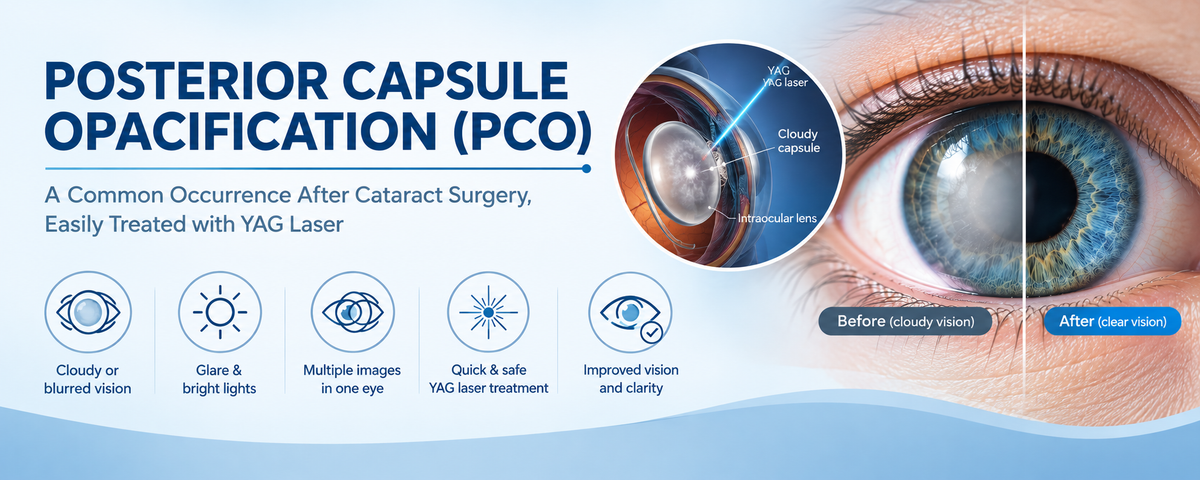
No, but you can develop a thickening or clouding of the posterior capsule membrane behind your new lens implant in the months or years following your surgery, which occurs in approximately one in 10 cataract surgery patients. This is called posterior capsular opacification and causes blurring of vision. This can be treated in an outpatient visit with a laser procedure, known as YAG laser capsulotomy. It is usually very effective, painless and quick, but can very occasionally cause complications such as retinal detachment or waterlogging of the central part of the retina. The risks of YAG laser treatment are smaller than the risks of the original cataract procedure and will be explained at your consultation.